Posts

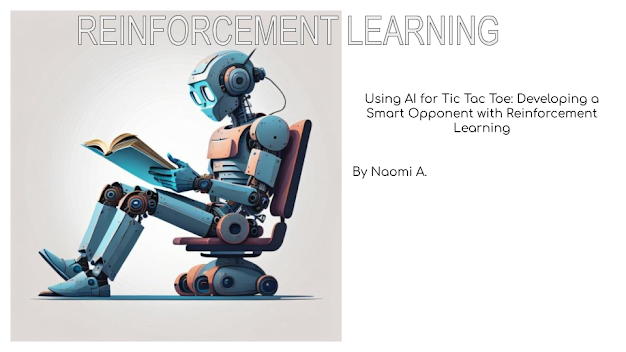
Teaching Computers to Play Tic Tac Toe: A Reinforcement Learning Approach
Image
 You can see the full code on GitHub: https://github.com/SQLNoggin/Smart-TicTacToe-RL_NaomiA.git This Python script implements a reinforcement learning agent to play the game of Tic Tac Toe. The agent is trained through Q-learning, a type of model-free reinforcement learning that uses a Q-table to estimate the value of taking specific actions in particular states. Let's break down the key aspects:   Overview The script uses the Tkinter library to create a graphical user interface (GUI) where the Tic Tac Toe game can be played. NumPy is used for numerical operations, and the pickle library is used to save and load the Q-table to/from a file. Constant and Hyperparameter Definitions PLAYER_X and PLAYER_O : Constants representing the two players (1 for X and -1 for O). EMPTY : Constant representing an empty cell on the Tic Tac Toe board. ALPHA : The learning rate used in the Q-learning updates. GAMMA : The discount factor used in the Q-learning updates. EPSILON_START, EPSILON_END,...

How to Create a Neural Network for Recognizing Hand-Drawn Shapes

Image
by Naomi A. In this guide, we will walk through the process of developing a neural network that identifies hand-drawn shapes. The tutorial is broken down into three main sections: Preprocessing the hand-drawn shapes. Training a neural network to recognize these shapes. Creating a simple user interface to predict the drawn shapes.   All code is available on github under the MIT License. (LINK TO REPO)    1. MNIST Maker: Preprocessing Hand-Drawn Shapes Objective : Convert the images of hand-drawn shapes into a standardized format for machine learning. Steps: Load the images from a specified directory. Convert them to grayscale and resize them to 28x28 pixels. Normalize the pixel values. Label the images based on their filenames. Shuffle and split the data for training, validation, and testing.  SCRIPT for creating the MNIST Dataset: import cv2 import numpy as np import os import random # Path to the shapes directory base_folder = r"C:\yourpathgoeshere" shapes = ...

Run Queries in SQL Server Using Python!

Image
By Naomi A. This is a fairly quick one - all of the info needed on how the script works is in the comments! The full script is ready for download on GitHub: (LINK) # Import the pyodbc module. #This module allows Python to connect to an ODBC database, like SQL Server. import pyodbc # The variables hold the server name, database name, username, and password. # This is necessary in order to connect to the SQL Server database. server = 'ServerName' database = 'DBName' username = 'user' password = 'password' # Connection string: # This is a formatted string that the ODBC driver uses to know who is connecting (username and password), # where they are connecting to (server and database), # and what driver they are using to make the connection (ODBC Driver 17 for SQL Server). connection_string = f 'DRIVER= {{ ODBC Driver 17 for SQL Server }} ;SERVER= { server } ;DATABASE= { database } ;UID= { username } ;PWD= { password } ' # DRIVER={{ODBC Dri...

Creating a Webpage - A Beginner's Guide (HTML, CSS, JavaScript)

Image
By Naomi A. Prerequisites: Before diving in, make sure you have access to a reliable text editor or integrated development environment (IDE) to create your HTML code. I personally recommend Visual Studio Code, an incredibly versatile tool that supports multiple programming languages. It's an excellent choice, especially for web development projects. Introduction: Welcome to this beginner-friendly demonstration of creating a simple web page using HTML, CSS, and JavaScript. In just 70 lines of code (with most of it dedicated to styling), you'll witness the possibilities that can be achieved! Please note that this is not an in-depth tutorial for HTML, CSS, or JavaScript. However, it serves as a great starting point for those who are curious about the potential of these languages. Here's a summary of what is covered here: The code starts with a document type declaration ( <!DOCTYPE html> ) specifying that it's an HTML5 document. The HTML structure consists of the <...

Power BI DAX: A Simple Introduction to Data Analysis Expressions

Image
 By Naomi A. Power BI allows users to create interactive visualizations and reports from their data. One key feature of Power BI is its ability to use DAX (Data Analysis Expressions) to perform calculations and analysis on that data. DAX is a functional language that operates on data stored in tables. It has a syntax similar to Excel formulas, but is more powerful and designed to work with larger datasets. Here are a few examples of how DAX can be used: Sum: The SUM function in DAX adds up the values in a specified column of a table. For example, if you want to find the total sales for a particular product, you can use the SUM function as follows: SUM('Sales'[SalesAmount]) Average: The AVERAGE function in DAX calculates the average of the values in a specified column of a table. For example, if you want to find the average sales for a particular product, you can use the AVERAGE function as follows: AVERAGE('Sales'[SalesAmount]) Filter: The FILTER function in DAX allows ...

Python in a Flash: Learn the Basics in Just 5 Minutes!

Image
  Python is a high-level, interpreted programming language that is widely used in various fields such as data science, web development, and artificial intelligence. It has a clean and simple syntax, making it easy to read and write code in Python. To get started with Python, you'll need to install it on your computer. Python can be downloaded for free from the official website, python.org .    Once you have Python installed, you can start writing Python code using any text editor, such as Notepad, Sublime Text, or Atom. Python code is executed line-by-line, and you can use the print() function to display output to the screen.    Example:   This code will display the text "Hello, World!" on the screen. Python supports many different data types, such as strings, integers, floats, and booleans.    Examples:   This code will display the text "Hello World" on the screen. Python also has built-in control flow statements, such as if/else statements ...

Pythonic Cheat Sheet: A Poem for Programmers by Naomi A.

Image
 Pythonic Cheat Sheet: A Poem for Programmers   Pythonic Cheat Sheet: A Poem for Programmers by Naomi A. With Naomi's cheat sheet, you won't be lost, you can use this at no cost!  Here are some functions you should know,  To help you code and make programs flow: First, there's the print() function,  To output your text without destruction.  Then, input() gets user data in,  A handy function, where to begin. Type conversion, with int() and str(),  To change data types, without a blur.  Also, len() measures length with ease,  For strings, lists, and more, it's a breeze. Math functions like round() and pow(),  To handle numbers, no need to row.  Max() and min() find the extremes,  For a list or data, it's just a dream. Want to sort your data? sorted() is your friend,  To organize your lists, beginning to end.  Slice your data, with [start:end],  A quick way to work on a chunk, my friend. Lastly, join() and spli...

Understanding How Python Syntax Works: Basic Concepts Explained

Image
By Naomi A. Python is a popular programming language known for its user-friendly and intuitive syntax. This article aims to introduce the fundamental concepts of Python syntax, including comments, variables, data types, and control structures, to beginners. Comments: Are an essential aspect of code documentation that helps programmers to understand the code's purpose. In Python, comments are indicated using the hash symbol (#).  Here's an example: Variables: Are used to store values, such as integers, floating-point numbers, and strings. To assign a value to a variable, use the equal sign (=). Here are some examples: Data types : Refer to the various kinds of values that can be stored in a variable. Python supports several data types, including integers, floats, strings, lists, tuples, and dictionaries. Here's an example:   Control structures: Such as conditional statements and loops, are used to control the flow of code execution. Conditional statements are used t...